
The Adoption Tax Credit 2026 brings major updates, including refundability up to $5,000 and new rules recognizing Indian tribal government determinations for special needs adoptions. These IRS changes help families save more money and ease the adoption process. In this guide, I break down everything you need to know so you can claim the credit confidently and correctly.
Overview of the New IRS Changes for 2026
The Treasury and IRS released FS‑2026‑03, announcing two major updates:
1. Refundable Adoption Tax Credit (Up to $5,000)
- Beginning in 2025, families can receive a refundable credit up to $5,000 (indexed for inflation).
- The remaining non-refundable portion can be carried forward for up to 5 years.
- Any unused amount after 5 years expires.
2. Recognition of Indian Tribal Governments
- Indian tribal governments now have the same authority as state governments to determine whether a child has special needs for adoption tax credit purposes.
These updates apply to tax years beginning after 2024.
What Is the Adoption Tax Credit?
The Adoption Tax Credit is a federal benefit that helps parents offset the cost of adopting a child. It applies to:
- Domestic adoptions
- International adoptions
- Private agency adoptions
- Foster care adoptions
For 2025, the credit covers up to $17,280 per eligible child.
Eligibility for the Adoption Tax Credit
You are eligible in 2025 if:
- Your MAGI is $259,190 or less
- The credit phases out between $259,191–$299,189
- Not available if your MAGI is $299,190 or more
- Married couples must file jointly
- Domestic partners may qualify in certain states
- You cannot claim the credit for adopting your spouse’s child
A “qualified child” is:
- Under age 18, or
- Physically or mentally unable to care for themselves
Qualified Adoption Expenses
These are allowed:
- Adoption agency fees
- Legal fees
- Court costs
- Travel, meals, lodging
- Home study fees
- Other necessary adoption-related costs
Expenses NOT allowed
- Adopting your spouse’s child
- Surrogate arrangements
- Costs covered by federal/state/local programs
- Employer-reimbursed expenses
- Any expenses used for another tax benefit
Employer-Provided Adoption Benefits (Exclusion Rule)
In 2025, you can exclude up to $17,280 from income if:
- Your employer has a written adoption assistance program
- Benefits are shown on Form W‑2, Box 12 (Code T)
The exclusion must be applied before the credit.
Special Needs Adoption Rules
Beginning in 2025, State and Indian tribal government determinations are both recognized.
A child qualifies as “special needs” if:
- The child is a U.S. citizen
- A state or tribal authority determines that the child:
- Cannot or should not return home
- Is unlikely to be adopted without assistance
Acceptable documentation includes:
- Adoption subsidy agreements
- Certificates from state/county/tribal welfare agencies
- Letters confirming special needs status
For special needs adoptions:
- You may claim the full credit, even without expenses
- You may claim the income exclusion, even without employer benefits
When to Claim the Adoption Tax Credit
Domestic Adoption
- If finalized → Claim expenses in the same year
- If not finalized → Claim expenses the year after paid
- If unsuccessful → Still claim (if child is U.S. citizen/resident)
Foreign Adoption
- Only claim when the adoption is finalized
- Past-year expenses can be included
Special Needs Adoption
- Claim when the adoption is finalized
How to Calculate the Adoption Credit
The credit is per child, not per year.
Example
If you claimed $3,000 in 2024 and spent $17,280 more in 2025, the 2025 credit is:
$17,280 – $3,000 = $14,280
Credit + Exclusion Example
If you paid $10,000 and employer reimbursed $4,000:
- $4,000 → Income exclusion
- $6,000 → Adoption tax credit
How to Claim the Adoption Tax Credit
- Complete Form 8839 (Qualified Adoption Expenses)
- Attach it to your tax return
- Include the child’s SSN, ATIN, or ITIN
- Keep all documentation
Amending Incorrect Returns
If the IRS changes or denies your credit:
- File Form 1040‑X
- Processing time: 8–12 weeks
- You may appeal if necessary
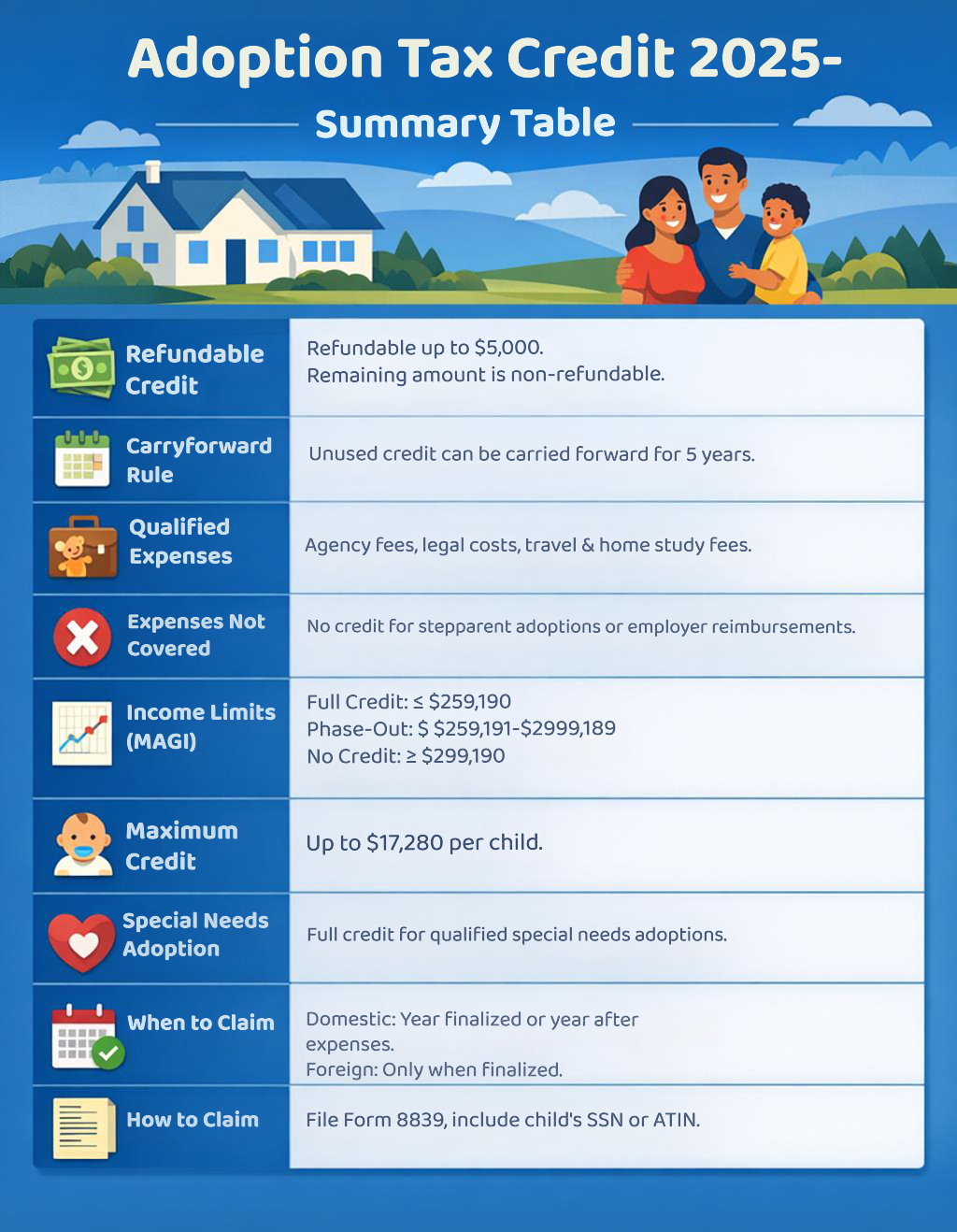
Adoption Tax Credit 2025 — Summary
| Category | Details |
|---|---|
| Refundable Credit (2025) | Refundable up to $5,000 (indexed for inflation). Remaining amount is non‑refundable. |
| Carryforward Rule | Non‑refundable portion can be carried forward for 5 years. Any unused amount after 5 years is forfeited. |
| Qualified Adoption Expenses | Agency fees, attorney fees, court costs, travel, meals, lodging, home study fees, and other necessary adoption costs. |
| Expenses That Do NOT Qualify | Adopting spouse’s child, surrogate arrangements, expenses reimbursed by employer, costs paid by government programs, or used for another tax benefit. |
| Income Eligibility (MAGI 2025) | Full credit: ≤ $259,190. Phase-out: $259,191–$299,189. Not available: ≥ $299,190. |
| Maximum Credit Per Child (2025) | $17,280 per qualifying child. |
| Employer Benefit Exclusion | Up to $17,280 can be excluded from income if employer offers a qualified adoption assistance program. |
| Special Needs Adoption (2025 Rules) | State and Indian tribal government determinations are accepted. Full credit allowed even with no expenses paid. |
| Documentation Needed for Special Needs | Adoption subsidy agreement, welfare agency certification, tribal government certification, or official letter confirming special needs. |
| When to Claim (Domestic Adoption) | If finalized → same year. If not finalized → year after expenses were paid. Unsuccessful adoption still qualifies (US child only). |
| When to Claim (Foreign Adoption) | Only when adoption is finalized. |
| How to Claim | File Form 8839, attach to tax return, include child’s SSN/ATIN/ITIN, keep documentation. |
| Amending Returns | Use Form 1040‑X if credit was claimed incorrectly or IRS adjusts/rejects the claim. |
Final Thoughts
The updated Adoption Tax Credit 2026 offers more support, especially with the new refundability and recognition of Indian tribal government determinations. These improvements make adoption more accessible and reduce financial burden for thousands of families.

Get the Latest Financial News, Expert Insights, Trends, and Tips you need to make Informed Decisions about your Business, Taxes, and Investments at edueasify.


